
Hero

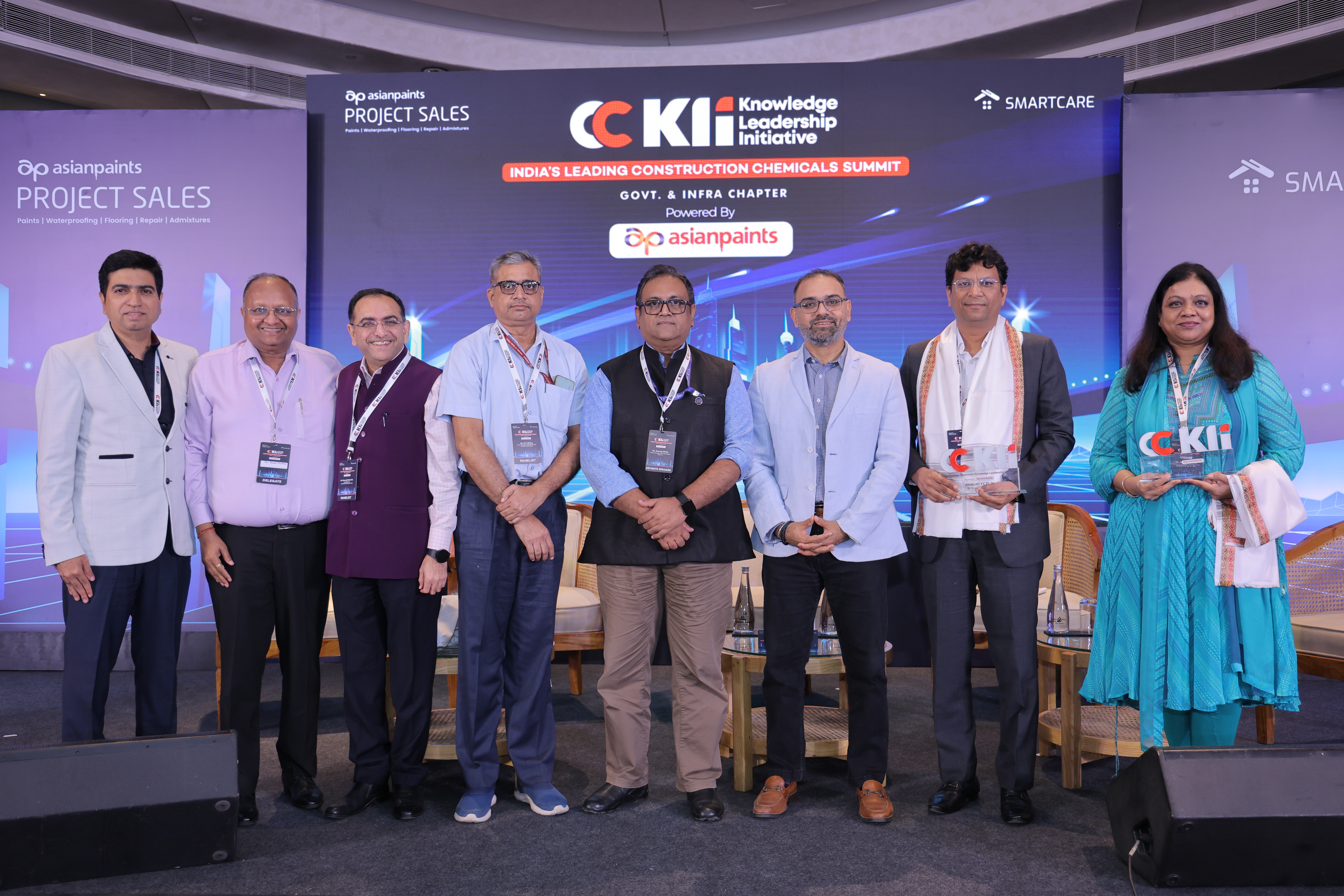
The Construction Chemicals Knowledge Leadership Initiative (CC‑KLI) is presented as a platform for structured knowledge exchange, convening domain experts to discuss sustainability and technical advances relevant to construction‑chemicals practice. 

The article frames CC‑KLI as a knowledge‑leadership mechanism designed to promote innovation and cross‑stakeholder learning in construction chemicals, particularly in relation to sustainability and emerging technical approaches. 

CC‑KLI is described as a convening forum that brings together thought leaders from academia, government, and industry to interrogate the evolution of materials, sustainable design, and performance‑based approaches that influence durability and efficiency in construction practice. 

Within the article’s organisational narrative, Asian Paints is positioned as having expanded from a household brand into a global participant in construction chemicals, with solutions spanning waterproofing, admixtures, industrial coatings, and repair‑oriented applications. 

The article further situates this evolution temporally, stating that over roughly the last 13 years the company has scaled its construction‑chemicals presence and broadened adjacent offerings, while also highlighting a long‑standing partnership with PPG Industries to access high‑performance coating expertise for industrial requirements. 

From Product Supply to Capability Development 

CC‑KLI is framed not as a single event but as a capability‑building intervention—an organised method for transferring know‑how on materials, sustainability, and performance‑driven construction outcomes across professional communities. 

Portfolio Structure and the Four Core Verticals.

The article characterises the construction‑chemicals offering as a portfolio of 330+ products arranged into four verticals intended to address water management, concrete durability, industrial flooring performance, and lifecycle extension of structures.

Partnership Logic in High‑Performance Coatings 

The article explicitly links capability in protective coatings to a long‑running partnership with PPG Industries, described as spanning 35+ years, enabling the use of specialised expertise for high‑performance industrial solutions.

Structural Health Assessment as a Precondition for Retrofitting Decisions 

The text argues that rehabilitation should begin with a clear definition of purpose and scope, because without that clarity, retrofit execution lacks a coherent technical basis.

It proposes diagnostic rating categories (e.g., “Very Good,” “Good,” “Fair,” “Bad,” “Critical”) as a practical classification approach that supports intervention selection, and notes that maintenance/retrofit frequency may vary from multi‑year intervals to quarterly checks depending on assessed condition.

It further emphasises root‑cause identification prior to intervention, and recommends evaluating strengthening against demolition/rebuild alternatives with safety and structural integrity as the dominant decision criteria, supported by a disciplined maintenance schedule post‑rehabilitation.

Rehabilitation Decision Workflow Extract

  • Define the purpose of assessment and strengthening before initiating rehabilitation work.

  • Perform structured diagnosis and rating (e.g., Very Good → Critical) to support selection of corrective actions.

  • Determine monitoring/maintenance frequency from assessment outputs (multi‑year to quarterly, depending on severity).

  • Identify and mitigate root causes of distress prior to rehabilitation to improve long‑term integrity outcomes.

  • Evaluate strengthening vs. demolition/rebuild with safety and structural integrity as priority constraints.

  • Institutionalise post‑rehabilitation maintenance planning to sustain performance over time.

Sustainability Themes: Zero‑Carbon, Zero‑Waste, and Evidence Frameworks 

The text highlights an emphasis on “zero carbon” and “zero waste” trajectories in construction, referencing approaches such as pre‑finished volumetric construction to accelerate delivery while reducing waste, particularly for cost‑sensitive housing applications.

It also references material substitution and blended systems, noting the use of composite cements and supplementary cementitious materials (e.g., GGBS) as pathways to reduce the carbon footprint of construction without compromising strength or durability when applied appropriately.

Environmental Product Declarations (EPDs) are introduced as lifecycle “passports” for materials—mechanisms intended to enable more informed decision‑making on environmental impact, with the article noting increasing adoption internationally and expectations of broader uptake in India.

Sustainability Levers Highlighted

  • Use process innovations (e.g., volumetric / prefabricated approaches) to reduce waste and accelerate delivery.

  • Apply low‑carbon material strategies (e.g., blended binders, supplementary cementitious materials such as GGBS) to reduce embodied carbon while maintaining performance objectives.

  • Adopt EPD‑style disclosure to compare lifecycle environmental impacts and support procurement decisions.

  • Improve energy efficiency across construction stages by optimising material selection and streamlining production procedures, as presented by the article’s sustainability framing.